Tarot Death Card: Meaning, Reversed & Love (Not About Dying)
The tarot death card almost never predicts a death. What Death (XIII) really means upright and reversed, in love and career readings — and what to do when you draw it.
By Paddy Picho. Published 2026-08-29. Updated 2026-08-29.
The tarot death card does not predict a physical death. Death (XIII) is the Major Arcana card of a definite ending — something genuinely finished, cleared away so that whatever comes next has room to exist. In practice, readers treat it as the card that names what you have already outgrown but are still carrying.
If your heart dropped when you turned it over, you are in extremely good company. Death has the most frightening name and the least frightening meaning of any card in the deck. Let's fix the fear first, then get into what it actually has to say to you.
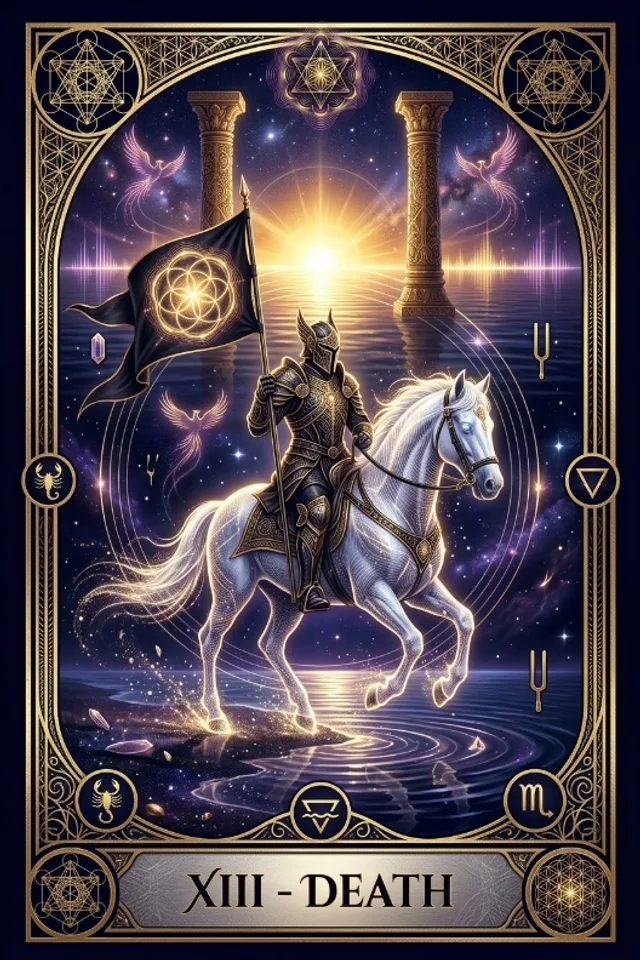
*Death, XIII, from the Resonance Deck. Note where the rider is heading: toward the sunrise, not away from it.*
What the Tarot Death Card Actually Means
Death is the thirteenth card of the Major Arcana, and its subject is transition — the moment a chapter closes for good.
Not "change" in the loose, hopeful, motivational-poster sense. Death is more specific and more honest than that. It points at something that is over, and it asks whether you have admitted that yet.
The card's traditional keywords are:
- Ending — something has run its course.
- Transition — you are between two states, not stuck in one.
- Clearing — space is being made, whether or not you volunteered.
- Conclusion — the decision has effectively already happened.
Here is the reframe that makes the whole card click: Death rarely arrives to tell you something is *going* to end. It usually arrives to tell you something already has, and you are still maintaining the building it used to live in.
The reading in one line: Death is not the loss. Death is the moment you stop pretending the loss hasn't happened yet — and that moment, uncomfortable as it is, is the beginning of relief.
No, It Doesn't Mean Someone Is Going to Die
Let's put this to bed properly, because it is the single most-searched question about this card and the fear is genuinely awful to sit with.
In the mainstream tarot tradition — the one every modern deck, including this one, is built on — Death is not read as a prediction of physical death. This is not a soothing modern edit. Readers have treated XIII as symbolic transformation for well over a century.
Three reasons that holds up:
- Tarot on this site isn't predictive at all. Every card here is a reflection prompt: a lens for looking at your own situation, not a forecast of events. A card cannot know your future, and no honest reader will tell you it can.
- The card's imagery is about crossing, not ending. The rider moves through water toward a rising sun between two pillars. It is a threshold image — a gate, not a grave.
- The literal reading has no practical use. If a card told you someone would die, what would you do with that? Nothing. Whereas "something in your life is finished and you haven't said so out loud" is information you can act on this week.
If you drew this card while genuinely worried about someone's health, the useful question is not *what is the card telling me* but *what is my anxiety telling me* — and that is worth a phone call, a check-in, or a doctor's appointment. Tarot is not a medical instrument. Nothing here is a substitute for professional advice.
Death Upright: The Ending That Clears Ground
Upright, Death is direct: something has concluded, and your job is no longer to save it. Your job is to notice, and then to let the space it occupied become available.
Where readers commonly see it land:
- A relationship that ended emotionally long before it ended logistically.
- A job or role you have quietly stopped believing in, but keep performing well.
- An identity you have outgrown — the version of you that a certain crowd, city, or habit belonged to.
- A belief you inherited and have never once examined as an adult.
- A routine that used to serve you and now just runs on schedule.
The uncomfortable part isn't the ending. It's the admission. Most people can survive loss far better than they can survive saying *this is over* out loud, because the sentence makes them responsible for what happens next.
Pro tip: When Death shows up upright, resist the urge to make a plan immediately. Naming what's finished is a complete step on its own. Plans made in the first hour of an admission are usually about soothing the discomfort, not about what you actually want.
Death Reversed: The Ending You Keep Postponing
Reversed, Death usually reads as an ending resisted, or one being dragged out well past its point.
Think of the difference this way. Upright Death is the door closing. Reversed Death is your foot in the door — the long, exhausting middle where nothing is over and nothing is beginning either.
Common reversed keywords and what they look like in real life:
- Resisted ending — you know the answer and you are negotiating with it.
- Drawn-out conclusion — the third "final" conversation about the same thing.
- Stagnation — nothing is technically wrong, and nothing has moved in a year.
Reversed Death is rarely a warning. It's more often a mirror, and the reflection is tiring to look at because the exhaustion in it is self-generated. Holding a door open takes constant effort. Letting it close takes one moment.
The question to sit with: What am I maintaining out of habit rather than out of use?
Death in a Love Reading
In relationship readings, Death gets misread as "breakup" almost automatically. Sometimes it is. Often it isn't. What it reliably points at is that the current version of the relationship has reached its end — which can mean any of these:
- A genuine ending, where the honest move is to stop.
- The end of a phase — the infatuation stage closing so something steadier can start.
- The end of a dynamic — a pattern of roles (rescuer and rescued, pursuer and pursued) that has finally worn through.
- The end of a story you tell about the relationship that no longer matches how it actually feels.
If you are single, Death in a love reading tends to be about the end of a type — the kind of person you have kept choosing, and the reason you kept choosing them.
The productive question here is not *are we breaking up*. It is: what are we still doing purely because we have always done it? Answer that honestly and the card has done its work, whichever way the relationship goes.
Death in a Career or Money Reading
In work readings, Death is one of the more useful cards in the deck, because careers are where people are most likely to keep a dead thing running.
What it commonly reflects:
- A role you've completed — not failed, completed. You have taken everything from it that it had.
- A career identity with an expiry date you have already passed.
- A project that should be killed, and everybody involved knows it.
- A skill or service you have built your income on that the world has quietly moved past.
Money-wise, Death leans toward restructuring rather than loss: closing an account, ending a subscription you forgot about, settling something long-outstanding, or letting go of a financial plan built by a version of you with different priorities.
Worth naming: "This is finished" and "I have failed" feel identical in the body and mean completely different things. Death is nearly always the first one.
Is the Death Card a Yes or No?
If you're doing a yes/no reading, Death is best read as: "Not in this form."
It is neither a clean yes nor a clean no, because the card's whole subject is that the question's premise has changed. Death answers a yes/no question by pointing at the question itself.
- Asking *should I keep going?* → Not like this.
- Asking *is it over?* → Yes, and you already knew.
- Asking *will it come back?* → Not in the shape it was.
For timing questions, Death is unusually unhelpful as a clock and unusually helpful as a signal. It doesn't say *when*. It says *this is already in motion, and the delay is on your side*.
Death Card Combinations Worth Knowing
Cards read differently in company. A few pairings that come up often:
- Death + The Tower — the ending isn't gradual. Something structural is going, fast. Focus on what you want to be standing in the rubble with.
- Death + The Sun — an ending you will be glad about. Rare and genuinely lovely.
- Death + Ten of Cups / domestic cards — a phase of home or family life closing, often a good one, ending anyway.
- Death + Temperance — the ending needs to be done slowly and deliberately, not in one dramatic gesture.
- Death + The Wheel of Fortune — this was cyclical, not personal. It was always going to turn.
- Death + a reversed card of the same theme — usually you asking the same question twice hoping for a different answer.
None of these are formulas. They're starting points for a conversation with yourself, which is all a spread ever is.
Death, Scorpio, Water and 285 Hz
Traditionally, Death is assigned the element Water and the sign Scorpio — the fixed water sign associated with depth, honesty, and the refusal to look away from difficult things. Fitting for a card whose only real demand is that you admit what you already know.
On this site every card is paired with a Solfeggio tone, and Death is paired with 285 Hz. That tone is traditionally associated with restructuring and renewal: the same movement the card describes, from an ending toward whatever follows it.
You can play it while you sit with the card — there's a button at the top of this article, and the tone keeps playing as you browse. It's not magic, and we won't pretend otherwise. What a single steady tone does reliably is give an anxious mind one uncomplicated thing to rest on, which is exactly the state in which this card is easiest to think about honestly.
If you want the mechanism rather than the tradition, Solfeggio frequencies for anxiety covers what the research does and doesn't support.
What To Do When You Draw the Death Card
A short, practical sequence. Fifteen minutes, no equipment.
- Breathe out first. The fear response to this card is faster than your reasoning. Give it a moment to pass before you interpret anything.
- Name one thing that is genuinely over. Not a list. One. Say it as a complete sentence, out loud or on paper: *"That part of my life is finished."*
- Ask what you're still maintaining for it. The habits, the calendar entries, the mental space, the explanations you give other people.
- Choose one piece of that maintenance to stop. The smallest one. Delete the folder, cancel the thing, skip the standing appointment once.
- Leave the space empty on purpose. Don't immediately fill it. Death clears ground; the next card is the one that plants something. Let there be a gap.
That's the entire practice. Death is not asking you to reinvent your life. It's asking you to stop paying rent on a room you moved out of.
The Reflection Prompt
Sit with this one for longer than feels comfortable:
What is already over that you are still keeping the structure of?
For the concise reference version of this card — keywords, upright and reversed in brief, the attributions and the paired tone — see the Death card meaning page. To pull it in an actual spread, draw a card or browse all card meanings.
FAQ
Does the tarot death card mean someone will die?
No. In mainstream tarot practice, Death (XIII) is read as symbolic transition — an ending, a conclusion, a clearing of ground — not as a prediction of physical death. On this site no card is read as a prediction of any kind; every card is a reflection prompt for thinking about your own situation. If you are genuinely worried about someone's health, that is a question for a doctor, not a deck.
What does the death card mean in tarot?
Death means a definite ending: something has concluded so that whatever comes next has room. Its keywords are ending, transition, clearing and conclusion. Most readings treat it as the removal of something you have outgrown but kept anyway — and often as the moment you finally admit an ending that has already happened.
What does the death card mean reversed?
Reversed, Death usually reads as an ending being resisted, or one drawn out well past its natural point. Its keywords are resisted ending, drawn-out conclusion and stagnation. The question to sit with is what you are maintaining out of habit rather than out of use.
Is the death card bad?
Neither good nor bad. No card in this deck is read as good or bad luck — Death is a frame for looking at a situation, and whether that frame is welcome depends entirely on what you are looking at. Many people find it the most relieving card in the deck, because it gives them permission to stop holding something up.
What does the death card mean in a love reading?
It points to the current version of the relationship reaching its end. That can mean a genuine breakup, but just as often it means the end of a phase, the end of a worn-out dynamic between two people, or the end of a story about the relationship that no longer matches reality. If you are single, it often reflects the end of a type you have kept choosing.
Is the death card a yes or no?
Read it as "not in this form." Death is neither a clean yes nor a clean no, because its subject is that the premise of the question has already changed. Asked whether to keep going, it answers: not like this.
What is the death card's element and astrological sign?
Traditionally Death is assigned the element Water and the sign Scorpio — the fixed water sign associated with depth and unflinching honesty. On Sacred Frequency it is also paired with the 285 Hz Solfeggio tone, traditionally associated with restructuring and renewal.
Which tarot card is number 13?
Death is card XIII, the thirteenth card of the Major Arcana. It sits directly after The Hanged Man (XII), the card of seeing a situation from a reversed angle, and directly before Temperance (XIV), the card of doing the next part slowly and in proportion. Read as a sequence: you see it differently, you let it end, you rebuild in measure.